
|
REHS performs
quarterly inspections of all radioactive material locations
and provides a copy of the inspection results to the
PI. This document explains the inspection checklist
used by REHS
Items marked
with an X for “unsatisfactory” should be corrected immediately.
Should you receive a Notice of Violation (NOV) as a
result of an inspection, you are required to respond
in writing.
ROOMS INSPECTED:
The
rooms listed under your authorization that are subject
to inspection.
SECURITY:
All
radioactive materials (RAM) must be secured. At
Rutgers this can be accomplished by locking the lab,
locking the refrigerator or freezer where RAM is stored,
storing RAM in a lock box, or by challenging any one
who walks into the lab. At UMDNJ security shall
be accomplished by locking stock RAM (using a lockbox
or installing a lock on the refrigerator, freezer) when
it is not in use or under direct surveillance, locking
labs that store RAM or waste when they are unattended
and by challenging anyone who walks into the lab.
LABELS:
All
doors into radioactive use labs must be posted with
the radioactive warning symbol. Similarly,
all equipment, hoods, refrigerator/freezers, instruments,
etc. used for radioactive experiments should be labeled
with radioactive tape or stickers. Any liquid
scintillation counters or gas chromatographs that contain
a radioactive source should possess a REHS label noting
the isotope.
POSTERS:
REHS
will check for the presence of the four required postings
in the lab and replace any that are missing, torn, or
out of date.
MONTHLY WIPES:
All
labs must perform a wipe test for contamination in any
month that radioisotopes are used. All wipes must
be expressed units of dpm, not cpm. The counter
printout sheet should be filed with the monthly wipes.
A detailed map of the wipe area should be present.
Areas of contamination greater than 100 dpm above background
must be cleaned, re-wiped, and documented in the monthly
wipe book.
MDA / EFFICIENCY:
Calculations
of Minimum Detectable Activity (MDA) and efficiency
must be performed and documented monthly. MDA
should be less than 100 dpm. An excel spreadsheet
that will auto-calculate these numbers for you can be
downloaded from our web site.
DAILY SURVEYS:
A personal
survey and a survey of the work area should be performed
with a survey meter after every use of radioactive material
and documented a minimum of once per day each day that
RAM is used. Hands, shoes, clothing etc., shall
be surveyed for contamination. A work area survey
should include floors, equipment used, and the regular
trash container.
APPROPRIATE SURVEY METER:
Survey meters are evaluated to make sure the survey
instrument owned by the lab is appropriate for the radioisotopes
used (i.e. a pancake GM or NaI probe).
METER OPERATIONAL:
REHS
will verify that the survey meter used for daily surveys
is in working order and that it responds to a known
source of radiation. Verify the meter has been
checked by REHS for efficiency in the past year.
PACKAGING AND LEAD DISPOSAL:
After RAM is delivered, the packaging and inner vials should be checked for contamination (posted our web site is the SOP for lab package receipt). Before boxes are put in regular trash, any radioactive symbols should be defaced. Lead should be wipe tested and meter surveyed for contamination. For disposal of lead, please see our web site for more information.
WASTE LABELED:
All
radioactive waste containers must be labeled with a
radioactive sticker and must have a yellow waste card
associated with them indicating the isotope and approximate
activity. Temporary waste containers should be
labeled with a radioactive sticker and either emptied
at the end of the day or have a yellow waste card associated
with it. If the lab supplies their own containers,
appropriate containers must be utilized.
PROPER SEGREGATION:
Radioactive
waste must be segregated according to isotope half-life.
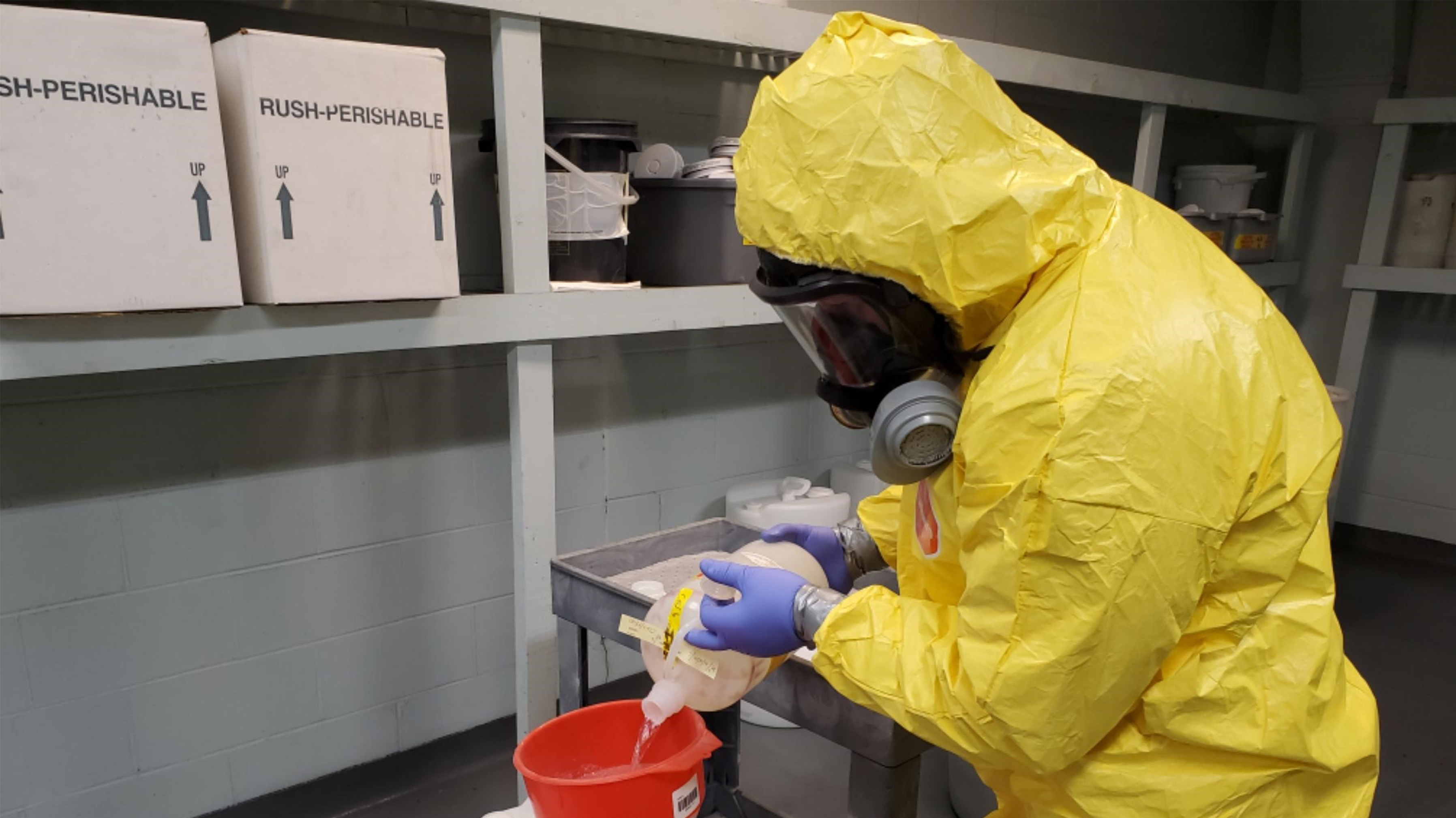
Drain disposal of liquid radioactive waste is prohibited.
SECONDARY CONTAINMENT:
All
liquid radioactive waste containers must be placed in
secondary containers capable of containing the volume
of radioactive liquid in the event of a leak.
Proper storage of the container with the lid tightly
closed is important.
EAT / DRINK / SMOKE:
Eating,
drinking, smoking or applying cosmetics in the labs
are prohibited. Food shall not be stored in RAM
labs. Evidence of food consumption, such as food
wrappers in trash cans, will result in a NOV.
DOSIMETERS WORN:
If
issued, radiation badges must be properly worn when
working with radioactive materials. Badges must
not be lent to others or stored near sources of radiation.
PPE UTILIZED:
Personnel protective equipment must be worn when handling
RAM. This includes double gloves, buttoned lab
coats and safety glasses. Shorts and open toe
shoes should not be worn when handling RAM. Shielding
should be used if necessary.
|
